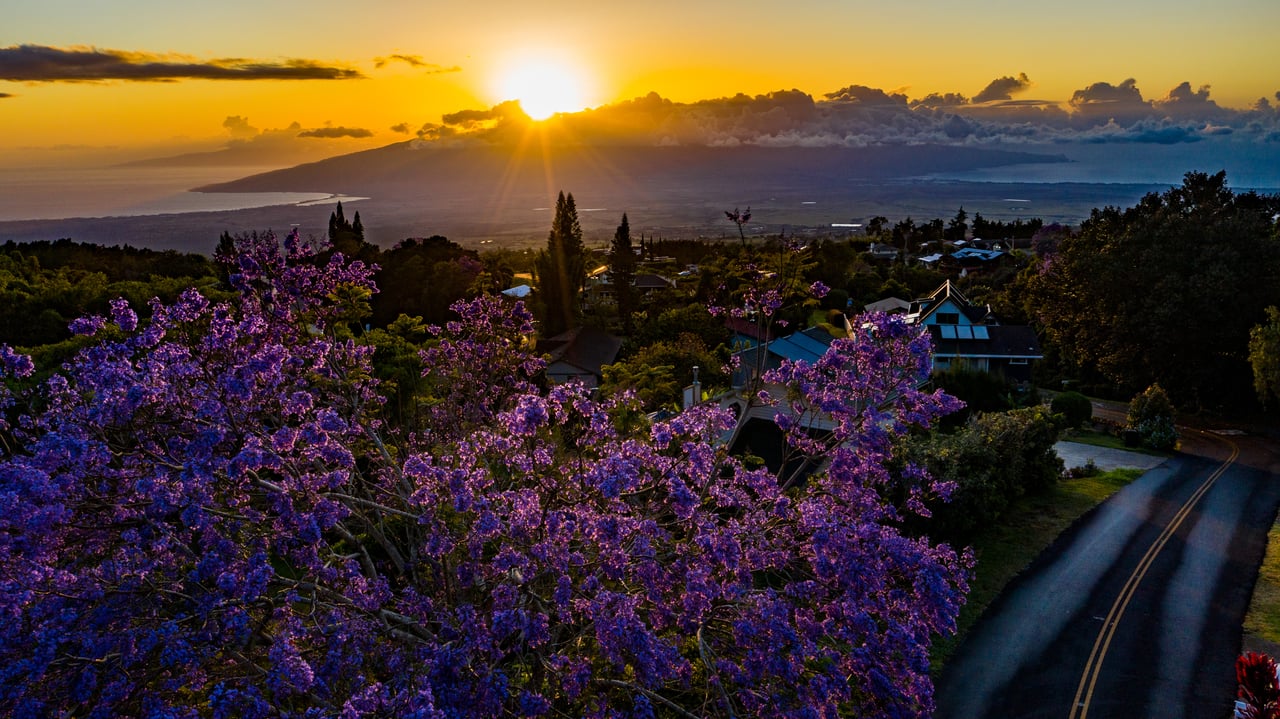
Ask anyone who lives in Pukalani where they're headed on a Saturday morning and the answer splits the town in half. Some are turning into the lot at Pukalani Terrace Center, at the corner of Old Haleakala Highway and Pukalani Street, for the same errands their parents ran there. Others are parking at Kulamalu Town Center, half a mile up the road, for a farmers market that didn't exist a generation ago and a pizza kitchen that didn't exist five years ago. Both centers sit on the same short stretch of road. Neither one has replaced the other. They've just settled into running on different clocks.
That split is the actual shape of daily life here, and it's easy to miss if you only think of Pukalani as one town with one main street.
The Errand Circuit Nobody Renamed
Pukalani Terrace Center has been the practical hub of Upcountry for decades, and it still functions that way. Foodland, Ace Hardware, a Bank of Hawaii branch, Starbucks, Supercuts, and a laundromat sit inside one lot, doing exactly what a neighborhood shopping center is supposed to do. None of it is trying to be a destination. It's where you go because you need something, not because you're choosing how to spend a free hour.
A few minutes away on the edge of town, Pukalani Superette has been open since 1955. Locals call it Puk Sup, and the shorthand tells you how deeply it's embedded in daily routine rather than any tourist itinerary. Seventy-one years in, its hot food counter, chili chicken, chow fun, and lau lau still function the way a corner store's kitchen is supposed to: fast, familiar, unchanged enough that regulars don't need to check the sign.
This circuit still carries the town's civic weight, too. Pukalani Terrace Center just wrapped its fifth annual Back-to-School Drive on July 18, run in partnership with the Boys & Girls Clubs of Maui, with donation bins set up at Ace Hardware, Kalei's Lunchbox, and the Bank of Hawaii branch. Prizes included Kula Country Farms gift certificates, a Fabianis gift card, and an overnight stay at the Maui Coast Hotel. It's a modest event by any measure, but it's the kind of recurring, dated commitment that tells you where a community still gathers to solve a practical problem together. Nobody's driving across town for that. It happens where the errands already happen.
A Newer Circuit Built Around a Parking Lot and a Wood-Fired Oven
Kulamalu Town Center reads as a plainer strip on the surface. Longs Drugs, the largest on Maui, anchors it, alongside a food truck lot that rotates through burgers, Thai food, and Cuban coffee depending on the week. But the corner of that lot facing Kupaoa Street has become something the Terrace Center never tried to be: a reason to plan a Saturday around it.
The Upcountry Farmers Market sets up there every Saturday from 7 to 11 in the morning, drawing organic growers, bakers, and florists into the same lot Longs has occupied for years. One block over, Restaurant Marlow opened in 2021 under chef Jeff Scheer and his wife Kaili. Scheer had been Maui's Chef of the Year in 2015 while running Mill House, and Marlow itself started as a pandemic-era habit, the two of them milling wheat berries and firing sourdough pizzas out of their home oven in Kula before turning it into a restaurant. Right beside Marlow sits Mahalo Aleworks, Upcountry's first brewery, opened by Ben and Jacquelyn Kopf after more than three years of permitting delays and false starts. It picked up Best New Brewery in Hawaii honors not long after it finally poured its first pint, largely on the strength of its rotating sour program and ingredients foraged from the slopes of Haleakalā.
None of that existed when the Terrace Center's oldest tenants moved in. It's a five-year-old node built almost entirely around one parking lot, and it now pulls people across town on a schedule the errand circuit never had.
A Saturday, Mapped by Hours
If you actually walk through the timing, the two circuits interlock in a way that only makes sense once you've lived it a few times.
- 7:00 a.m. The Upcountry Farmers Market opens in the Kulamalu lot, and Marlow's kitchen opens at the same hour for breakfast.
- 11:00 a.m. The market starts winding down as Marlow shifts into its lunch service, which runs until 2:00 p.m.
- Noon. Mahalo Aleworks opens its doors, running food-free until either Marlow or the Upcountry Sausage Co. cart on its lanai covers the hunger gap.
- 2:00 to 4:30 p.m. Marlow's kitchen closes between lunch and dinner. Mahalo Aleworks stays open through this window, which means anyone drinking there in the early afternoon is ordering from the sausage cart, not the pizza oven next door.
- 3:00 to 5:00 p.m. Happy hour runs at the brewery.
- 4:30 p.m. Marlow reopens for dinner, serving until 9:00 p.m., the same closing hour as the brewery.
That two-and-a-half-hour kitchen gap in the middle of the afternoon is the kind of detail you only learn by getting caught in it once. It's a small seam in an otherwise tight loop, and it's the clearest evidence that this circuit is still young enough to have rough edges the older one long ago smoothed out.
A brewery that took three years just to open its doors, a restaurant that started in a backyard oven, and a folding table of Upcountry produce are now the reason people cross town on a Saturday.
Two Civic Engines, Running in Parallel
What's notable isn't that one center is thriving while the other fades. Both are doing exactly what they've always done, just for different reasons. Puk Sup has run its hot food counter since 1955 without needing to reinvent itself. The Terrace Center still organizes the town's back-to-school giving every July. Meanwhile Kulamalu's newer tenants have built enough of a following in five years that Mahalo Aleworks' sour program and Marlow's sourdough have become the kind of thing residents mention almost the way longtimers mention Puk Sup, as shorthand everyone in town understands.
Neither circuit is competing with the other for the same errand or the same hour. The Foodland run and the farmers market run serve different purposes, even on the same Saturday. That's the part that surprises people who assume a small Upcountry town operates on one shared rhythm. Pukalani doesn't. It runs two, and most residents have simply picked one without ever mapping out why.
What the Split Actually Means
None of this is really about pizza or produce. It's about how a town this size ends up organizing itself into distinct functions without anyone planning it that way. The errand circuit stayed anchored to the businesses that have been doing the same job for decades. The social circuit grew up around a parking lot that happened to have room for a market, then a restaurant, then a brewery, each one arriving within a few years of the last. Both circuits are still running. Neither one is going away. And most people who live here have quietly built their week around whichever one fits their errands, without ever noticing that the other half of town is running on an entirely different clock.
If you're curious how a specific Upcountry property sits relative to either circuit, or what a longer view of Pukalani's growth looks like from someone who has watched both sides of town develop, contact Riette Jenkins for a private consultation.